All Insights
.avif)
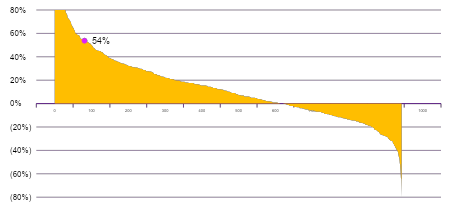
And yet – the school results keep getting better (and places ever more competitive), the roads (despite the crushing traffic given that the population has grown nearly 50% in 6 years) are ever widening, the restaurants grow more eclectic, the art and music scene continues to explode, and the people just keep coming. Throughout it all, and through the natural growing pains of success (see the chart below on Dubai’s worsening traffic), Dubai continues to imagine and innovate. The regulatory environments in the DIFC and the ADGM drive continued asset management relocations (as mentioned earlier), but beyond that, regulations for digital assets, for business formation and dissolution, and for freelancers continue to improve as they are tested at scale. More importantly, the business boom, rather than being merely in residential real estate, moved firmly beyond Dubai and Abu Dhabi in 2025, expanding towards Sharjah, Ras Al Khaimah, and the other emirates.
Dubai’s growth has created unprecedented investment opportunities in public equity, particularly in digital consumer services from tolling to parking to delivery that are all investable and growing rapidly. Competition is ever present, but so is growth and innovation. In the coming years, we expect to see companies such as Salik and Parkin further expand their footprint in Dubai beyond the central business districts, and to continue to add services. Similarly, companies like Talabat and their many private competitors continue to grow rapidly and evolve their offerings for Dubai’s young, wealthy, and consumption-oriented residents. Even in legacy verticals such as financial services and real estate, digital innovation continues to accelerate, and demand is so strong that such innovation is easily funded, creating a flywheel that measurably improves both financial performance for developers and banks, and the quality of their offerings.
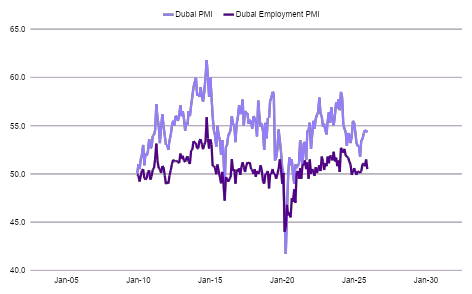
When we look at quantitative metrics of improvement, particularly Dubai’s monthly PMI readings, what’s remarkable are the gains in productivity marked by 3 years of output expansion far above employment expansion. Simply – net new employees in Dubai are highly skilled and upskilling, and output has grown well above simple population increase, due to an increasingly productive workforce.
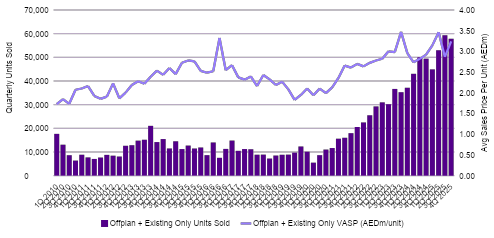
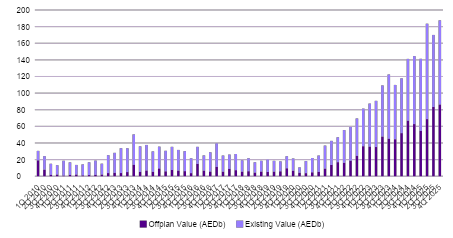
No discussion of Dubai can be complete without discussion of its meteoric real estate market, which marked another record year in 2025 (we’ve called the peak for the past 4 years – and so has everyone else – but the demand function is clearly far more robust than we anticipated), with 867b USD in real estate transactions, 35% of them new build, and the remainder secondary sales. A half decade of growth has seen the entrance of numerous new real estate players, with the market share in off plan sales for Emaar Properties, the long-time market leader, falling to 10% from 20%, while they themselves report a 10% growth in sales! An amusing tidbit: this fall, a developer no one in our office had heard of put billboards all over the city advertising themselves proudly as “Dubai’s 7th largest Developer!” which may in fact be more impressive than it seems! Most importantly, the regulatory rigor that Dubai’s authorities have enforced on the property market since 2010 means that cash flow across the sector remains very healthy despite the high volume of sales and activity, given us comfort that the authorities will manage what must inevitably slow down.
\
Further Reading
\
Get the latest insights
We share perspectives, research, and market insights to help investors and founders see where growth is emerging — and how to capture it. Discover what others might be missing.

Investment Manager: Ajeej Capital (DIFC) Limited, regulated by the Dubai Financial Services Authority (DFSA). Ajeej Capital (AD) Limited regulated by the Financial Services Regulatory Authority (FSRA) of Abu Dhabi Global Market (ADGM). FSP No. 180021. © Ajeej Capital 2026